Threads for Transformation

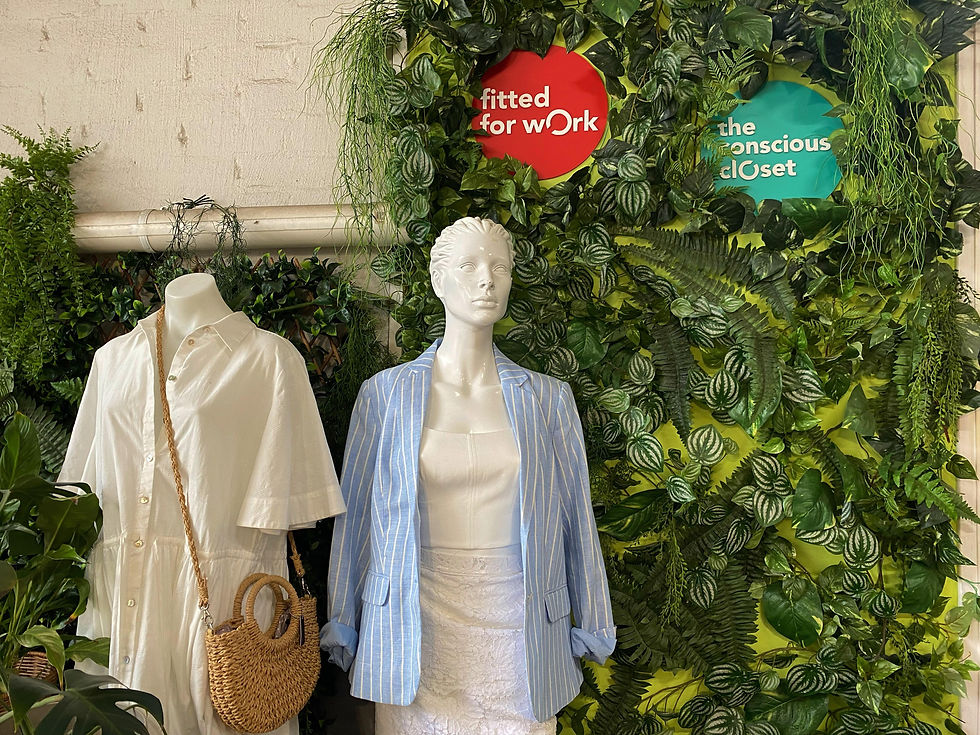
The Conscious Closet's Entrance
Written by: Darci Holmes, Ashley Lee and Leah D'cruz
Whether you are familiar or unfamiliar with the sustainable fashion community, you would probably have come across the term, “circular fashion” before. What we know of the circular fashion economy today is that it is defined to be a redirection of garments from landfills to a second home. It seems to be the way to go for the fashion economy.
But first of all, we need to understand fashion’s present linear economy. Currently, our textiles move in a linear fashion model where our garments appear to be exorbitantly produced, shortly used and when we no longer think they are nice to wear anymore, we discard them, creating a constant cycle. When these garments are disposed of, it either ends up at landfills or is incinerated.
Melbourne is a city that homes a myriad of vibrant, inspiring and eclectic fashion styles, where its people are unafraid to express themselves through fashion. This is apparent through the existence of festivals such as Melbourne Fashion Week and PayPal Melbourne Fashion Festival. Whether you are rushing to board the train to work, strolling to your next class on campus, getting your afternoon pick-me-up coffee or driving back to pick up your kids, every Melbournian has a quirky flair to be remembered and talked about.
Reuse
Every piece of garment that lands in the warehouse premises of The Conscious Closet (TCC) is unique and distinctive. Disguised in its assortment, the overflowing bags of donations bury the many stories of each garment. It seeks to tell its narrative before arriving at TCC.
Amongst the pile of clothes in the donation bags, each cotton T-shirt, cotton pants, leather jacket, linen shorts, came from somewhere before arriving in the hands of TCC’s volunteers. It could be that T-shirt that got her first teaching award after being away from teaching for a long time or the cotton pants that got his first job post grad. Each garment could be a symbol of a milestone in someone’s life, relaying an account of every garment owner’s narrative.

Donations from TCC's donors

Donations from TCC's donors
When one steps into the store, one cannot help but marvel at the sights, smells, noises. As one browses through the plethora of clothing pieces available, one will begin to realise the many patterns, texture, materials and colours exhibited by each clothing item. From the elaborate details of each piece, it is a vivid portrayal of the quality care provided by TCC’s volunteers whilst in curation of the many bags of donated clothes. Whether it is a T-shirt, pants, shorts, jacket, trousers, shoes, sandals, sweaters and the list goes on, TCC embraces the variety of styles that come in through the doors. Be it a bright pink colour, a coarse texture, a tiger-print pattern, a silky material to the garments, the volunteers welcome and appreciate the beauty of these that make a garment what it is.
With the love bestowed upon TCC, it is not surprising news that the organisation receives an unconditional amount of love and support from anonymous donors and fellow industry partners.
An anonymous donor who donates “Meaningful pieces that I have worn to special occasions and have been a part of milestone memories,” shares how these “items that have been a part of my wardrobe for many years and have been loved, such as vintage and designer suits and dresses.” For many of us; fashion is more than just clothes and garments. Just like this donor, it is about identity, self-expression and holds many milestone memories close to us.

The Conscious Closet's Vintage Gowns
When asked about why she loves contributing to TCC, she says “I love donating to TCC because it's lovely to see clothing that I have a connection with, go to a new home and be loved as much as I loved it when I first purchased and wore it.”
TCC is a space where reusing garments and fashion styles is reborn. This is fuelled by the close-knit relationships that The Conscious Closet has forged with fellow organisations in the fashion industry, including Witchery, Elk and Dear Gladys, among others.
Earlier this year, Witchery donated almost half a million dollars worth of stock to TCC and in 2020, customers of Witchery were urged to contribute gently used apparel in exchange for a $10 Witchery gift card.
Similar to Witchery, Elk, an ethnically designed clothing brand, supports non-for-profit organisations like TCC through donations in cash, products or paid volunteer hours. In 2021, the organisation donated a total of $126K.

Donations from ELK and Witchery

Donations from ELK and Witchery
“Sometimes items like samples or one-offs are still in perfect condition but didn’t make it into the ELK collection. We love that these clothes can still be worn, valued and loved through their programs,” said Elk’s Sustainability Assistant, Stephanie Nicdao.
“Partnering with FFW is an important demonstration of our ELK value of Community, allowing us to make connections locally and provide support to our community,” said Stephanie.

Fitted For Work's Donation Bins

Fitted For Work's Donation Bins

Fitted For Work's Cashier and Countertop
Revolutionise
In a world of fast fashion and fleeting trends, it's easy to forget that our choices as consumers hold incredible power. The act of buying a garment is not merely an exchange of money for cloth; it's a statement of values, a choice with far-reaching consequences. The fashion industry has long been criticised for its environmental impact and labour practices, but there's a new movement emerging—one that reimagines fashion as a force for good and a bridge to address one of society's most pressing issues: unemployment.
The Covid-19 pandemic has left the globe in shock, leaving the human race to pick up the pieces and bear the brunt of its repercussions. Unemployment rates in Australia were 3.5% in June 2023, and are expected to rise.
For single mother Nicole, employment was a major concern of hers, amplified by her experience battling with mental health. As such, she sought help from Fitted For Work to set her desires of employment in the right direction.
“I was finding it hard to push forward and rebuild the life I was seeking to achieve the quality of life that I felt I truly deserved.” Nicole shared.
“I am employed again. I have my identity back.” said Nicole.
Fitted For Work (FFW) challenges the status quo and inspires us to rethink what fashion can do. It's not just a store; it's a beacon of hope, a catalyst for change, and a symbol of sustainability in a fast-fashion world. At its core, TCC, dares to be different. It rescues discarded fashion treasures, breathes new life into them, and channels 100% of the profits back into creating change. This isn't just about clothes; it's about a vision deeply rooted in the idea that high-quality, pre-loved clothes deserve a second home.
But what makes TCC truly transformative is its collaboration with FFW, a national nonprofit organisation, dedicated to empowering women experiencing disadvantage, particularly in their pursuit of economic security. Female unemployment is an issue that persists worldwide, and the statistics are telling. Women, especially those from marginalised communities, face significant barriers to employment.

The Environment
Those in female-dominated industries such as healthcare, education and retail are not spared of its consequences. They make up 79%, 64% and 57% respectively according to data on the annual Workplace Gender Equality report in 2020.
“Many of our clients are single parents and identify that they need to put food on the table. They feel the need to accept the first role they are offered, as they don’t have the luxury of waiting for a dream job,” said Melanie Browne, acting CEO of FFW.
So, how does a fashion store and an employment-focused nonprofit align? The answer lies in a beautiful symbiotic relationship. TCC doesn't just sell pre-loved clothing; it generates profits that are channelled directly into Fitted for Work's impactful client services. This funding fuels resume and cover letter support, personal outfitting, job-readiness workshops, and mentoring. In essence, TCC isn't just a fashion store; it's a lifeline, helping women rebuild their lives.
20% of FFW’s employed clients are in unstable or unreliable working environments and are looking for more sustainable employment.
Unpredictable working hours, low compensation, workplace bullying, care obligations, physical and/or mental health concerns, and other factors are only a few of the many causes for leaving jobs.
Melanie also says: “The disproportionate impact of the Covid-19 pandemic on women highlighted that these barriers are layered and complex. If we are to raise the workforce participation rates of women in Australia, we require a unique and tailored solution, but current employment support models are falling short.”
“If this trend persists, we'll be faced with an entire generation of women entering their later years at risk of poverty and homelessness.”
The impact of TCC extends beyond statistics. It's about the faces behind the transformations. From the volunteer staff dedicated to a mission of empowerment to the donors who understand the power of their contributions, it's a community of change-makers. Every purchase, every donation, becomes a symbol of collective action.
Lauren Brown, Senior Account Manager of THINK HQ, Lead of Victorian Education, a government funded initiative to increase employment rates within the education sector feels that “The collaboration between The Conscious Closet and Fitted for Work serves as a reminder to educators facing unemployment that creative solutions exist beyond traditional job searches. It encourages us to think outside the box and explore avenues for empowering those seeking employment.”
In a world driven by the values of sustainability, authenticity, and social impact, TCC speaks to the aspirations of a new generation—the torchbearers of change. For them, it's not just about getting a bargain; it's about making choices that matter. It's about embracing circular fashion and realising that every garment tells a story, from its previous owner to its new beginnings.


TCC and FFW are stitching together a narrative of hope, sustainability, and empowerment. In a world that often seems consumed by consumption, they offer a different path—one that leads to transformation, inclusion, and conscious choices. As this movement gains momentum, it reminds us that a single stitch can be a part of a much larger narrative, where fashion doesn't just adorn bodies; but lives.


Comments